
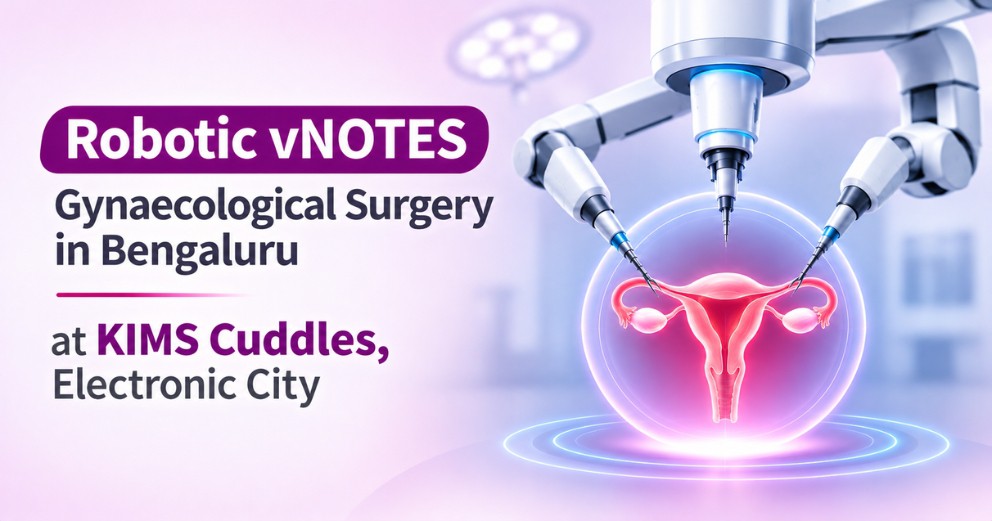
Robotic vNOTES means a gynaecologist may operate through the vagina with robotic help, no tummy scars. Dr. Lavanya Kiran at KIMS Cuddles, KIMS Hospitals, Electronic City offers it. She is one of the very few surgeons in Bengaluru to combine vNOTES with robotic surgery.
What Is Robotic vNOTES and Why Are Women in Bengaluru Asking About It?
If you’ve been informed you require gynaecological surgery, your initial concerns are probably about scars, recovery and what the operation means for your life. The robotic vNOTES removes these concerns. The surgeon enters through the vagina, the body's natural opening, and inserts a camera and fine equipment into one small port. They are robotically assisted and controlled by the surgeon from a console. The full name is vaginal natural orifice transluminal endoscopic surgery.
Will Robotic vNOTES Leave Any Visible Scars?
There are no cuts on the abdomen, so there are no visible scars. Healing happens inside the vagina, out of sight. Many women find this especially reassuring if they already carry a caesarean scar and would rather not add another.
How Long Does Recovery Take After vNOTES Surgery?
Studies of vNOTES compared to normal keyhole surgery performed without a robot report shorter hospital stays and less discomfort with vNOTES. Most women are urged to walk early on. Your recovery plan will be designed for your individual procedure and will advise you when to go back to work, when to drive and when to avoid heavy lifting.
Age, general health and the purpose for surgery all play a part thus recovery is rarely the same for two women. Ask your surgeon what is normal for you and call the hospital if something doesn’t seem right when you get home.
Can Women Who Want Children Have vNOTES Surgery?
This is a direct conversation. Hysterectomies remove the ability to carry a pregnancy, and aren’t a choice for women who want to have children. Other therapies that may spare fertility are feasible, in which the uterus can be retained. Dr. Kiran has experience in reproductive health and fertility-sparing work, so your hopes for a family are part of the conversation from the very first session.
Is Robotic vNOTES Possible After a Caesarean or If You Have Never Delivered Vaginally
Neither situation automatically rules it out. Women who are overweight, who have had a caesarean or who have never delivered vaginally can be considered in selected cases. Whether the vaginal route is safe for you depends on an examination and scans, and your surgeon will tell you plainly if another approach is better.
How Strong Is the Evidence for Robotic vNOTES?
vNOTES is a recognised technique. The first hysterectomy by this route was reported in 2012, and a 2026 review in Obstetrics & Gynaecology and a NICE procedure overview both discuss it. The meta-analysis supports shorter stays and lower pain compared with vNOTES and non-robotic keyhole surgery. Research on the robotic-assisted version is still limited because it is newer. You deserve to hear that from your surgeon.
Why Choose Dr. Lavanya Kiran for Robotic vNOTES at KIMS Cuddles, Electronic City?
Dr. Lavanya Kiran is a gynaecologic surgeon at KIMS Hospitals, Electronic City. Her profile lists vNOTES among her areas of expertise, alongside robotic surgery and reproductive medicine. She operates on the da Vinci Xi platform available at KIMS Hospitals, Bengaluru, within a hospital that offers multispecialty and intensive care support.
At your first consultation, expect time to talk. You will describe your symptoms and history, have an examination and scans, and hear every option laid out, including non-surgical ones. Nobody will ask you to decide on the spot, and you are welcome to bring a family member for support.
When Should You See a Gynaecologist About Pelvic Symptoms?
Do not wait if you notice very heavy or prolonged periods, pelvic pain that keeps returning, bleeding between periods or after menopause, or a fibroid or cyst that is growing. Difficulty conceiving alongside any of these is another reason to book. An early conversation with a gynaecologist gives you more choices, and many women feel relieved simply to understand what is happening. It also opens up options, including some that avoid surgery altogether.
Robotic vNOTES FAQs
1. Does robotic vNOTES leave a scar?
No scar is left on the abdomen, because the surgery is done through the vagina. Any healing happens inside the body, so nothing shows on your skin, including near an older caesarean scar. Your surgeon will explain what to expect in the first few weeks.
2. Where can I have robotic vNOTES in Bengaluru?
Dr. Lavanya Kiran offers robotic vNOTES at KIMS Cuddles, KIMS Hospitals, Electronic City. She is one of very few gynaecologic surgeons in Bengaluru who combine vNOTES with robotic surgery, and she operates on the da Vinci Xi platform available at the hospital.
3. Is it suitable if I want a baby later?
A hysterectomy ends the ability to carry a pregnancy, so vNOTES hysterectomy is not suitable if you hope to have children. Other treatments that keep the uterus may be possible, and Dr. Kiran will go through them with you, drawing on her background in reproductive medicine and fertility-sparing work.
4. How do I start?
Book a consultation at KIMS Cuddles, KIMS Hospitals, Electronic City. The first visit is a conversation about your choices, with an examination and scans where needed, and no pressure to decide. Your questions about scars, recovery, work and family are all welcome.