Every parent faces this decision at some point, often late at night, often without access to the GP who knows their child, and often with the very human tendency to either catastrophise or underestimate what they are looking at. The question of when a child needs emergency care rather than watchful waiting at home is one that deserves a clear and specific answer, not a vague instruction to trust your instincts.
Instincts are useful. But some knowledge of what to look for makes the decision considerably easier and more reliable.
Always Attend Emergency Care Immediately
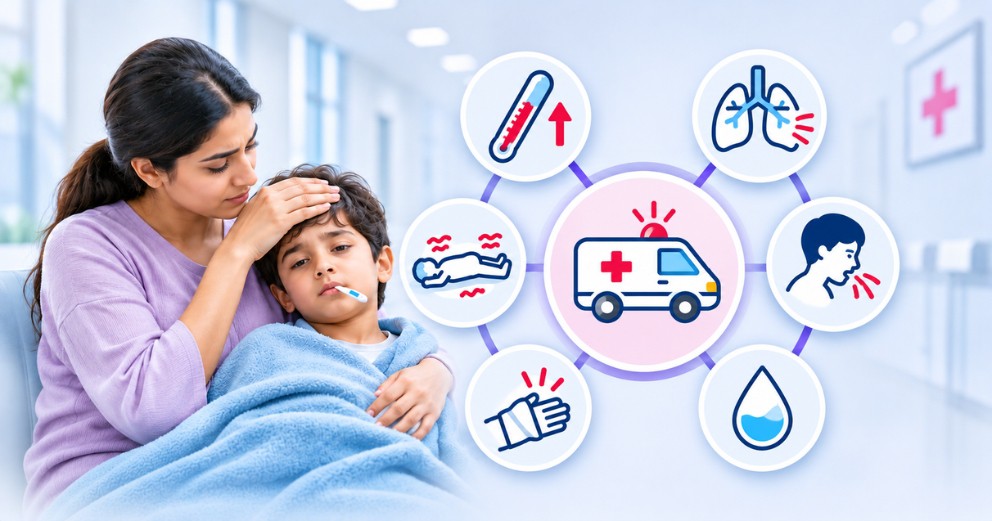
There are presentations where the decision is not a judgement call. These require immediate attendance at a paediatric emergency department in Electronic City or the nearest available facility:
- Breathing difficulties - Laboured breathing is not the same as fast breathing. A child who is breathing quickly but comfortably may have a fever or mild illness. A child showing visible effort, using the muscles of the neck and shoulders to breathe, with the chest wall pulling inward with each breath, or with the nostrils flaring, is working hard to breathe and needs assessment without delay. Any blue colouration around the lips is a medical emergency.
- Altered consciousness - A child who cannot be roused normally, who is unusually unresponsive, confused, or who does not recognise familiar people needs immediate assessment. This includes a child who appears to be sleeping but cannot be woken appropriately.
- Non-blanching rash - A rash that does not fade when pressed under a glass or a finger, particularly accompanied by fever, requires emergency assessment to exclude meningococcal septicaemia. This is the clinical situation where the window for effective treatment is measured in hours.
- First seizure - Any child who has a seizure for the first time, regardless of duration, requires emergency evaluation. Febrile convulsions are common and generally benign, but they require assessment, and a prolonged seizure lasting more than five minutes requires emergency intervention.
- Severe allergic reaction - Facial or tongue swelling, throat tightness, difficulty swallowing, hives spreading rapidly, or any combination of breathing difficulty and skin reaction after exposure to a potential allergen requires immediate attendance and adrenaline if available.
- Fever in a baby under three months - A temperature above 38 degrees Celsius in a baby under three months requires same-day medical assessment regardless of how well the baby appears. The immune response in this age group is immature and the risk of serious bacterial infection is substantially higher than in older children.
- Suspected poisoning - Any suspected ingestion of a medication, household chemical, or unknown substance requires immediate assessment regardless of current symptom level, because the clinical deterioration may be delayed.
- Significant head injury - A head injury accompanied by loss of consciousness, repeated vomiting, persistent severe headache, confusion, or unusual drowsiness requires emergency evaluation.
- Severe abdominal pain - Pain that is severe, worsening, or accompanied by rigidity of the abdominal wall warrants urgent assessment.
Presentations That Need Same-Day Assessment But May Not Require Emergency
Some presentations need medical attention the same day but may not require the emergency department if a paediatric clinic is accessible and can see the child promptly. These include a child who is unwell but not critically so, who has a fever that is high but responding to paracetamol, who has an earache or sore throat causing significant distress, or who has a rash that needs assessment but is not the non-blanching pattern described above.
The distinction matters because child emergency care in South Bengaluru at a dedicated pediatric emergency department is the right setting for genuinely urgent presentations, and pediatric clinic assessment is more appropriate and often faster for presentations that are serious but not immediately life-threatening.
When to Trust the Instinct Alone
When a parent says their child does not seem right without being able to name a specific symptom, that observation deserves to be taken seriously. Parents know their children, and the sense that something is wrong, even without a specific presenting complaint, is a valid reason to seek assessment. At KIMS Hospitals, Electronic City, our paediatric urgent care team in Electronic City takes this seriously.
The Specific Signs Worth Memorising
For families across Electronic City Bengaluru, Neeladri Nagar, Anekal, and Hosur Road, knowing these warning signs before a child is unwell is considerably more useful than trying to recall them at two in the morning:
- Breathing that looks difficult rather than just fast
- Rash that does not fade under pressure
- Fever in a baby under three months
- A seizure
- Unusual unresponsiveness or confusion
- Throat swelling or difficulty swallowing
- Suspected poisoning
- Head injury with any neurological sign
Conclusion
Every parent will face this decision more than once. The goal is not to arrive at the emergency department for every fever or scraped knee, nor to talk yourself out of going when something genuinely needs attention. Knowing the specific warning signs in advance, before your child is unwell and before the anxiety of the moment clouds your judgement, is the most practical thing you can do. When in doubt, go. The team at KIMS Hospitals, Electronic City is available around the clock, and no parent has ever regretted getting their child checked out when it turned out to be nothing. The same cannot be said for waiting too long.